
By Ivan Kesic
- Arak was founded in 1808 as Sultanabad, a planned military fortress designed by a French engineer on a grid layout inspired by the city of Nice, making it one of the few Iranian cities built according to a deliberate urban plan.
- The city's historic bazaar, constructed from 1813 onward, remains a living commercial center whose caravanserais and covered passageways once connected the agricultural wealth of the Farahan plain to the great trading houses all around Iran.
- Arak's industrial base, anchored by the country's first aluminum plant, first locomotive and wagon factory, and first combine plant, has earned it recognition as the fourth industrial pole of Iran and the informal title of the country's industrial capital.
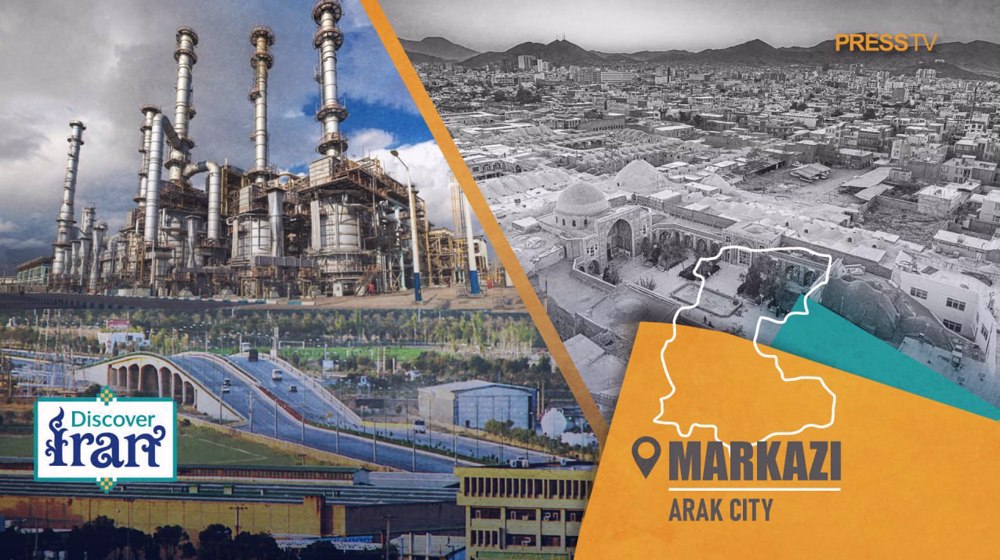
Arak, the capital of Markazi Province in west-central Iran, presents a distinctive example of how a planned Qajar-era settlement evolved into a major industrial city.
Founded as Sultanabad in the early nineteenth century, the settlement was initially intended to strengthen central government authority, improve security and establish a strategic administrative and military center in a region where tribal power and unreliable transport routes complicated state control.
Its subsequent development, however, extended far beyond these original objectives. Agricultural production, carpet weaving, international trade, railway construction and state-led industrialization successively reshaped the city's economy and urban landscape.
At the heart of this transformation stands the historic bazaar of Arak, which connected the agricultural hinterland with merchants, artisans and distant markets and became particularly important during the late nineteenth and early twentieth centuries, when Sultanabad developed into one of Iran's leading centers of commercial carpet production.
Planned city in the Qajar period
The area around present-day Arak holds traces of settlement dating back to the Median and Sassanid periods. The site of contemporary Arak belongs to a much more recent chapter of Iranian history. The origins of modern Arak lie in the reign of Fath-Ali Shah Qajar (r. 1797-1834).
Historical ources associate the foundation of Sultanabad with Yusef Khan Gorji, a military commander entrusted with extending the authority of the central government in the region. The precise foundation date varies between sources, from 1808 to 1816.
The choice of location reflected the political and geographical circumstances of the period. The wider region, historically known as Iraq-e Ajam, occupied an important position between the central Iranian plateau and the western approaches towards the Zagros Mountains.
Establishing a fortified settlement offered the government a means of consolidating authority, protecting communications and supporting military and administrative activity.
A French engineer, Trezer, who had accompanied General Gardane's mission to Iran during the Napoleonic era, drew up the plans, and the layout was modeled on the French city of Nice.
The town within the walls followed a strict checkerboard pattern, with a bazaar placed close to the central crossroads and defensive walls punctuated by numerous towers.
Sultanabad differed from many Iranian cities that had grown gradually around older settlements, religious institutions or established commercial centers.
Its development followed a comparatively regular plan, laid out in a rectangular, checkerboard pattern and enclosed by a defensive wall equipped with numerous towers.
The bazaar was positioned near the central crossroads, making it an integral part of the planned settlement rather than an independent commercial quarter that developed at a much later date.
The original military rationale did not prevent Sultanabad from becoming commercially important, since a more secure settlement could attract inhabitants, artisans and merchants from surrounding villages, and as the population increased, the town became a point of exchange between agricultural producers and traders who could connect regional goods to markets farther afield.

Historic bazaar: architecture and economic function
The historic bazaar remains one of the clearest physical expressions of Sultanabad's original urban design. Situated in the old central district, it formed the commercial core of a city whose prosperity depended on the relationship between the surrounding countryside and the growing urban population.
The bazaar served as a major center for the sale of agricultural products and for trade in carpets from the central and western parts of the country, particularly those associated with the Saruq carpet-producing region.
Architecturally, the bazaar is a covered commercial complex rather than a single enclosed building.
Its network includes shops, passageways, courtyards, caravanserais or commercial courtyards known as saray, specialized trading halls known as timcheh, and associated religious and public facilities, including the historic Sepahdari Mosque and Madrasa, now associated with the Imam Khomeini seminary.
Its combination of commercial, religious and educational functions reflects the traditional Iranian bazaar's role as a center of urban life rather than merely a place for retail transactions.
Brick masonry and vaulted construction are prominent features of the bazaar. Arched and domed roofs cover many of its passageways, shops and commercial spaces, while roof openings admit daylight and assist ventilation.
The arrangement of interconnected corridors and courtyards supports movement between different sections of the complex and provides space for storing and handling goods.
Such architectural forms were suited to a commercial environment in which merchandise might arrive in bulk, remain in storage and be redistributed through a network of smaller traders.
Different sections could accommodate particular types of merchandise, merchants or commercial operations, and warehousing and wholesale trade existed alongside retail activity, allowing the complex to function as a meeting point between local producers and larger trading networks.
The bazaar also connected economic activity with religious and social life. Mosques and schools provided spaces for worship, education and community interaction, while commercial relationships encouraged the exchange of information, credit and professional knowledge.
The historic complex should consequently be understood as a multifunctional urban institution whose buildings helped organize trade, but whose broader significance lay in the relationships between commerce, civic life and the surrounding city.

Carpet production and the expansion of international trade
Sultanabad's rise as a commercial center accelerated during the second half of the 19th century. Although carpet weaving was already practiced in the surrounding region, the industry expanded as international demand for Persian carpets increased.
Skilled workers in local villages supplied production, while merchants and commercial firms developed systems for collecting, financing, storing and exporting carpets.
Sultanabad became one of Iran's principal centers of carpet production and trade during the late Qajar period, with growing involvement of foreign trading companies, local merchants and Armenian commercial participants in the city's export economy.
The Swiss trading house Ziegler & Co. was particularly influential. The company established a presence in Sultanabad in the late 19th century and developed a large commercial depot and warehouse whose complex included storage facilities, staff accommodation and yarn-dyeing installations.
The scale of this expansion is illustrated by historical estimates of the number of carpet looms: approximately 1,200 looms in Sultanabad in 1894, compared with only around 40 when the Ziegler representative Alpiger first arrived, while nearby villages reportedly had another 1,500 looms and a separate contemporary estimate placed the total for the wider district at approximately 5,000.
These figures indicate the magnitude of the industry's growth, even if they should be treated as historical estimates rather than a definitive census.
Sultanabad's carpets were part of a commercial chain extending well beyond the city. Merchants organized production and collection, commercial firms handled orders and distribution, and export networks transported finished goods to overseas markets, with exports routed through Tabriz and Trebizond, a Black Sea port that connected inland Iranian commerce with international shipping.
This expansion altered the city's relationship with its hinterland, as agricultural households and rural weaving communities became increasingly connected to urban merchants and foreign buyers.
In this sense, the carpet economy represented an early form of export-oriented economic development in the region, resting on a combination of traditional craft production and increasingly organized export trade.
War, political change and new commercial institutions
The commercial expansion of Sultanabad did not proceed uninterrupted. The Constitutional Revolution and the political changes surrounding the end of the Qajar period coincided with wider instability.
The First World War disrupted trade and transport across Iran, and historical research identifies the war years and subsequent political and economic insecurity as factors that slowed the city's development.
Nevertheless, the city's commercial role persisted. During the early 20th century, new organizational and administrative institutions began to complement the older trading system, with the establishment of financial institutions, a chamber of commerce and joint-stock companies.
These developments reflected a broader change in the organization of Iranian economic life, as commerce increasingly involved formal institutions and corporate structures alongside traditional merchant networks.
The bazaar remained important during this transition, continuing to accommodate shops, commercial courtyards and storage facilities even as new administrative offices, transport links and industrial enterprises changed the wider city.
Old and new systems operated alongside one another, reflecting the gradual nature of Iran's economic transformation.

Railways and the transition to modern industry
One of the most consequential changes in Arak's development was the expansion of modern transport infrastructure.
The completion of the Trans-Iranian Railway through the city by 1938 strengthened Arak's position as a transport and distribution center, connecting it to wider national routes and improving the movement of goods, fuel, industrial materials and people.
The railway made the city more attractive for modern industrial facilities that required reliable access to raw materials, machinery, labour and markets, since industrial production operates on a different scale from traditional bazaar commerce and requires large sites, substantial capital investment, specialized equipment and continuous supplies of energy and transport services.
Towards the end of the first half of the 20th century, Arak acquired several modern factories, including facilities producing sugar from sugar beet, vegetable oil, soap and wool products.
These enterprises represented an intermediate phase in the city's transformation, more mechanized and capital-intensive than household craft production, but their establishment also reflected the importance of agricultural resources and established commercial networks.
The growth of these industries illustrates a broader pattern in Iranian modernization, as state policy increasingly sought to strengthen national transport, encourage domestic production and reduce dependence on imported manufactured goods.
Arak benefited from this environment because its location and existing commercial role made it suitable for industrial investment.

Heavy industry and the emergence of an industrial center
The most dramatic shift came during the mid-20th century, particularly from the 1960s into the early 1970s, when the city's economy expanded beyond agricultural processing and traditional commerce into heavy engineering, metal production and industrial machinery.
Two major enterprises illustrate this transition. The Iran Aluminium Company, commonly known as IRALCO, was established in 1964 as a joint venture involving Iran and international partners, and the plant began operating in 1972 with an initial capacity of approximately 45,000 tonnes per year, subsequently expanded in later phases.
The other major development was the heavy engineering plant known as Machine Sazi Arak, which opened in 1972 with Soviet equipment and technical assistance, its establishment linked to an agreement under which Iranian gas exports to the Soviet Union helped finance industrial cooperation.
While the aluminium plant involved American corporate participation and regional cooperation, the heavy engineering project relied on Soviet equipment and expertise, demonstrating that Arak's industrialization was not simply the result of one foreign partnership or one national policy.
It emerged through a combination of state planning, international technical cooperation, investment, transport infrastructure and the expansion of domestic manufacturing.
The industrial base subsequently broadened to include enterprises associated with construction machinery, railway vehicles, agricultural machinery and industrial equipment.
Companies such as HEPco, Wagon Pars, MAPNA and AzarAb became associated with the city's modern industrial identity, their activities connecting Arak to national infrastructure programmes, agriculture, energy production and heavy manufacturing.
However, the development of these industries should not be understood as a straightforward replacement of the earlier economy, since traditional commerce, smaller workshops and industrial enterprises continued to coexist. Industrial growth also changed the city's social and spatial structure, as large factories required a workforce with different skills from those needed in carpet production and bazaar retail, and the demand for industrial employment encouraged migration from surrounding rural areas.
Arak's population increased from 71,925 in 1966 to 114,507 in 1976 and further to 520,944 in 2016, a rate of growth substantially above the country's natural population increase during that period.
The expansion of factories thus had consequences beyond industrial output, contributing to urban growth, changing employment structures and strengthening Arak's role as a regional center for services, administration and transport.
Through its covered passageways and the caravanserais that once hosted merchants from across the region, the bazaar tells the story of a city that was built to serve the needs of a vast and fertile hinterland, and that eventually became one of the anchors of Iran's industrial economy.
 This makes it easy to access the Press TV website